
__________Layered Curriculum®. . . because every child deserves a special education™_
 |
|
 _
_ 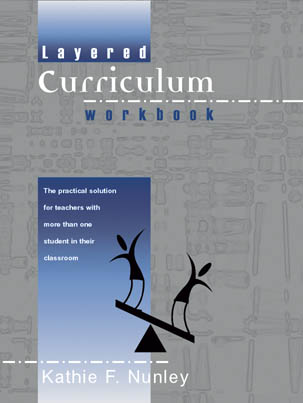
Layered
Curriculum TEXT & WORKBOOK
Set
for only
$43.95
(free shipping in
US)
Tweet
Accountability Begins at the BeginningBy Dr. Kathie F. Nunley
The cry for accountability is louder than ever. Across this country communities, districts, and states are asking for more accountability in schools. States want districts to prove their validity in quantitative ways. Year-end state mandated exams are becoming the rule rather than the exception. Administrators and teachers are feeling increased pressure to bring test scores up and failure rates down. The classroom teacher is faced with the dilemma of teaching the curriculum without teaching the test per se. (Although teaching the test is not a problem, as long as the test is valid and reliable - but that's a separate article.) One of the biggest problems with the accountability cry is that it tends to focus down to the teacher, and then stops there.
Accountability for learning needs to go one step further - to the student. Amazingly, students have never been held accountable for day to day learning. End of unit tests or chapter tests have implied accountability, but as most classroom teachers can attest, that is a wild assumption. Students do not see the relationship between learning activities and accountable learning.
Ask a student to defend a homework assignment and then sit back and watch their shock! Why, it has never occurred to them that they were supposed to have learned from the assignment. They thought they were just supposed to "do" it.
Here's a typical first time oral defense of homework:
Teacher: So tell me Sarah, what were some of the experiments which lead to the discovery of the double helix structure?
Sarah: "huh?"
Teacher: The homework from last night...I see here you did answer that question. I believe it was the first question in the section - what research helped lead Watson and Crick to their model of DNA?
Sarah: I don't know...I just wrote it down.
Teacher: Do you remember anything about what you wrote?
Sarah: No, I was just trying to get it done.
Teacher: Well tell me something, anything, that you learned from your homework?
Sarah: Well, I don't know...but I did it, doesn't that count?
Unfortunately, no one should be surprised by a conversation such as above. Somehow, in public education, the relationship between class and home activities and learning has not be clarified to students. Amazingly, as silly as it sounds, students do not know that are supposed to learn from daily schoolwork. They have become accustomed to getting credit for "doing" assignments with no accountability, so that is what they do.
All assignments in my classes require an oral defense. As people who have followed my work know, I consider oral defense the cornerstone to my teaching methodology. Accountability must begin at this level. When students realize credit is not given if learning does not occur, a paradigm shift begins. Their simple and innocent response of "You mean I did all that for nothing?" opens up the lines of communication about school, assignments and learning. Because, let's be honest - if they learn nothing from the activity, then it truly was done for nothing.
(Originally written in 2004, this article may be used in any nonprofit print publication so long as it is used in its entirety including the bottom author credit paragraph).
About the Author:
Dr Kathie Nunley is an educational psychologist, researcher and author of several books on parenting and teaching, including A Student's Brain (Brains.org) and the best selling, "Differentiating the High School Classroom" (Corwin Press). She is the developer of the Layered Curriculum® method of instruction and has worked with parents and educators around the world to better structure schools to make brain-friendly environments. In addition, her work has been used by the Boeing Corporation, Family Circle Magazine, the Washington Post, and ABC television.
Email her: Kathie (at) brains.orgCopyright © 1998 - current year by Kathie F. Nunley.
All Rights Reserved.
Layered
Curriculum is a registered trademark developed by
Dr. Kathie F. Nunley.