
__________Layered Curriculum®. . . because every child deserves a special education™_
 |
|
 _
_ 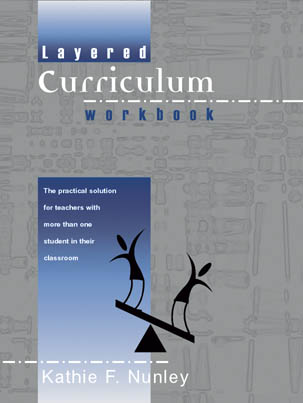
Layered
Curriculum TEXT & WORKBOOK
Set
for only
$43.95
(free shipping in
US)
Tweet
Accountability: RequiredBy Dr. Kathie F. Nunley
Hold students accountable for day-to-day learning and watch end of the year test scores increase. Unfortunately traditional teaching has not encouraged students to see the connection between daily classwork and learning. That's because there is no systematic accountability for that work. Students are accustomed to "doing" an assignment and getting credit for the "doing" rather than the learning.
We all know that having an assignment such as a worksheet filled out does not necessarily indicate students have learned anything. Sometimes it just means they sit with the right people at lunch, or can fill out paperwork while watching television at home.
If students can get enough daily work "done" to offset low test scores, it is possible (sadly) to pass a course while learning very little if anything about the subject matter. Theoretically you could go through twelve years of this and come out with a diploma and little else.
Hold students accountable. Give credit for actual learning, rather than for doing. Daily quizzes, either oral or written, are easily administered. Choose one question at random
from the assignment and give a grade based on that assessment. Choose two of their ten vocabulary words and award points on the two words. Write sample math problems on
index cards, have the students draw a card, complete the problem and award homework points based on that sample of work.In the beginning, students may be shocked, even angry at the change in strategy. But stick to your policy, explain the reason, and eventually your students will actually come to
appreciate the fact that you care enough about them to value the time they've spent on learning.About the Author:
Dr Kathie Nunley is an educational psychologist, researcher and author of several books on parenting and teaching, including A Student's Brain (Brains.org) and the best selling, "Differentiating the High School Classroom" (Corwin Press). She is the developer of the Layered Curriculum® method of instruction and has worked with parents and educators around the world to better structure schools to make brain-friendly environments. In addition, her work has been used by the Boeing Corporation, Family Circle Magazine, the Washington Post, and ABC television.
Email her: Kathie (at) brains.orgCopyright © 1998 - current year by Kathie F. Nunley.
All Rights Reserved.
Layered
Curriculum is a registered trademark developed by
Dr. Kathie F. Nunley.