
__________Layered Curriculum®. . . because every child deserves a special education™_
 |
|
 _
_ 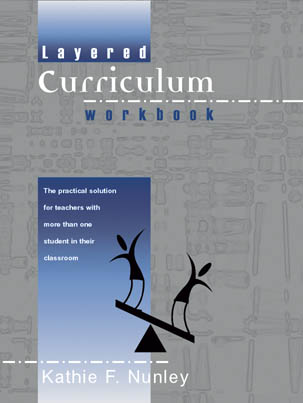
Layered
Curriculum TEXT & WORKBOOK
Set
for only
$43.95
(free shipping in
US)
Tweet
Active Research Leads to Active Classrooms
© Dr Kathie Nunleyfrom NASSP's "Principal Leadership," March 2002, pg. 53-61.
Doing your own brain-research
There is a cautious whisper circulating through the educational community that we educators shouldn't be too quick to jump on the brain-based education bandwagon. What we need to do is wait. Wait for neuroscientists to tell us how all this new brain research applies to the classroom.
What educators don't realize is that neuroscientists don't know where to start. They are not teachers. Neuroscientists are not in the classroom. They do not know the questions we want answered. We as educators, need to tackle our most cherished classroom questions head-on. The technology is here. The need to know is now.
We are doing just that here in Salt Lake City. As teachers, we have teamed up with the neuroscientists who pioneered magnetoencephalography (MEG). MEG works by measuring the tiny magnetic fields outside the head created by the electrical activity occurring inside the working brain. MEG allows scientists to see brain activity in both time and space. This means that not only can we see the area of activity and we can now see the sequence of activity. For the first time ever, we can watch the actual processing of brain activity almost neuron by neuron.
We are seeking answers to three of education's most pressing questions - Are students' learning style preferences visible in the way their brains process information? What are the effects of classroom stress on learning? How do extrinsic rewards effect the learning process?
Our work began when the two pioneers in MEG technique, William Orrison and Jeff Lewine, brought their work to the University of Utah's research park in 1998. They established a center for MEG clinical work called the Center for Advanced Medical Technology (CAMT). Upon hearing about this new technology, my teaching colleague, Gene Van Tassell and I saw a potential opportunity to research the learning preferences of our students. As educators we were excited about the possibility of using the MEG technique to "see" how our students process what is presented to them. Could we watch them actually think and learn?
To begin our project we recruited subjects from our school district through newsletters and PTA publications. Through newspaper articles and a website, we widened our subject search throughout the state. The adolescents, aged 13-19, are first screened for their learning style preference. Students are administered the Dunn, Dunn, & Price Learning Style Inventory (LSI). Although, this LSI uses several categories of style, we categorize students based on auditory and visual preferences only. After the paper and pencil test for learning style, the subjects are sent to the CAMT at Research Park for the MEG imaging test. During the MEG test, students are asked to perform various learning tasks. Some tasks required them to listen to information (process auditory stimuli), other tasks asked them to look at pictures (process visual stimuli) and some tasks asked them to process both stimuli simultaneously.
After the MEG testing is done, the neuroscientists at the CAMT give us a picture of our students' brain activity. Squiggle lines indicate electrical activity in 122 areas of the cortex as detected by the sensors in the MEG during the testing. The activity can be stopped at any fraction of a second in time by taking a "picture" of current activity. The larger and more erratic the squiggles, the more activity in that particular area.
Preliminary results have indicated several important discoveries. Although we screened hundreds of subjects, we had to eliminate subjects with any head trauma or emotional disturbance (such as depression). As we learned, any trauma, such as a three year old falling out of a wagon and hitting his head, could mean significant plasticity in the brain, thus distorting normal processing. So, we discovered that "normal" brains are hard to find.
During the MEG scan, if a subject was able to process both auditory and visual stimuli simultaneously (as shown by having electrical activity on the MEG scan in both regions) we determined them to have no sensory preference. However, in some subjects, when presented both stimuli simultaneously, their brains only processed one stimuli. The MEG showed activity in only one sensory region, the other region's activity was flat. These subjects were considered to have a sensory preference. For example, in one test, a 16 year old male student was given information visually on a screen and aurally through headphones at the same time. The MEG picture showed lots of brain activity in the occipital region in the back of his cortex (visual area) but no activity whatsoever in the temporal region(auditory area). Apparently, at the instant that his brain was receiving information from both eyes and ears, this student's brain did not process the auditory information at all, only the visual. So the brain showed a preference for visual information.
Of the 25 subject whose brain images have been interpreted so far, we have the following MEG results:
10 subjects with a visual preference
1 subject with an auditory preference
14 subjects with no preference.
This suggests there may be a pre-wired sensory "preference" in some students' brains. In some people, the brain may prefer auditory information so that it takes priority over visual information. These may be the same type of people that have a hard time reading while background noise is present. In this type of learner, the brain gives priority to auditory information so it is hard to filter that out in order to concentrate on the visual information in reading. Other students' brains show a preference for visual information. These students may be the ones who can easily read with background noise present. Their brains have no problem giving preference to visual information. However, these students may have a hard time blocking out visual information in order to listen to a lecture.
Thus far in our research, nearly half of the students' brains show a sensory preference. Some have a stronger preference than others. Obviously, diversity exists in how fast students are able to shift back and forth between processing visual and auditory information to make sense out of any situation. Most of us have experience with students who have a very difficult time processing visual or auditory information quickly.
Another result from our project is that although these preferences vary from student to student, they do not necessarily match with their paper-and -pencil learning style test. When comparing the LSI results with the MEG results we have the following matrix:
Preferences LSI Visual (6) LSI Auditory (6) LSI No preference (13) 10 with Visual MEG 1 3 6 1 with Auditory MEG 0 0 1 14 with no MEG pref. 5 3 6
The above matrix can be interpreted as follows:
Of the 10 adolescents which the MEG showed to have a visual preference, the LSI found 1 to have a preferred visual learning styles, 3 to have an auditory learning style, and 6 had no preferred learning style.
We have found no correlation between MEG sensory preference results and learning style results as measured by the LSI. A student's LSI may show that they are auditory learners but the MEG may indicate a visual preference or vice versa. It may be that the brain's sensory preference is not the same thing as learning style. Learning style generally includes social and emotional aspects of learning rather than the biology of the brain. Paper LSI tests usually rely on students' self-report of their learning preference. The MEG looks only at the physical brain response without regard for social and emotional environmental preferences. So the MEG results suggest that students may not necessarily know their brain's preference for processing sensory stimuli.
Previous to this type of research and these types of brain-imaging techniques, educators were forced to rely on anecdotal information for what we know about how students learn. This no longer needs to be the case. We now have physical evidence of diversity in how students learn. Neuroscientists are looking for more areas to apply their techniques. Education is an excellent area for application. However, progress requires that educators take an active role in the research process. Following any research in brain-imaging, educators must then take their findings back to the classroom for practical application.
Applying the research to your own classroom
How have we applied these latest MEG sensory preference findings? First, by thinking about how classrooms present information in both visual and auditory forms. Unless students have their eyes shut during a lecture, they are receiving sensory information through both senses. In students whose brains "prefer" visual stimuli, the information coming from their eyes may mask the information coming from their ears. So the lecture may be weakened by extraneous visual stimuli around the room or strengthened though visual displays pertaining to the lecture.
Because self-reports may not be valid and school systems do not have MEG machines available for teacher use, assessing students' learning preference does not appear to be practical. Therefore, teachers must make sure that instructional materials are available for every type of learner that may be in the room. We have realized the "my way or no way" type of teaching will not work in a general, mixed ability classroom. Traditionally, many teachers thought the problem was that students just needed to try harder. It appears that "trying harder" is not the answer for students, but for teachers.
We need to try harder to accommodate the diversity of our students' learning preferences. Most of us have known for years that there are no regular students in regular education. Therefore, the movement toward whole-class curriculum modification appears to be an answer for teaching in a heterogeneous classroom.
Based on what education has extracted from brain research, and supported from our current project, I developed one such whole class curriculum method I call Layered Curriculum. I call it layered because it divides the level of study into 3 layers, A, B and C. In my classroom, students choose from a variety of assignments, a variety of textbooks, a variety of hands-on materials.
The bottom layer, called the "C" layer, allows students to collect information on a topic from a variety of student-chosen material. They pick and choose from approximately 20 assignment choices all worth varying points. Assignments include videos, bookwork from a variety of text, magazine articles, posters, models, flashcards, and computer work. Now if Jose' learns best from hands-on models, and Sara learns best through reading, both students can learn in their preferred method.
All grading or assessment at this layer is done through oral defense. Every assignment, whether bookwork, flashcards, videos, posters, models, or computer work has an oral quiz, one-on-one between teacher and student. I can move quickly around my room during every class period and spend a few minutes with each student to check for comprehension, correct errors in their thinking and help direct their individual learning. I get personal face time with every student every day. The students get individualized help for student-chosen assignments. (For more information on oral defense see my article, In Defense of the Oral Defense, in February 2000 ASCD's Classroom Leadership.)
The middle layer called the "B" layer in Layered Curriculum asks students to apply what they've learned in the "C" level. Here again, students are given choices in how to apply, create or discover more information but this time, of their own design. In my biology classroom this is done by providing questions for which students must find an answer through a lab of their own design. I give several questions for them to choose from and they must find the answer.
The top or "A" layer requires a critical analysis on a topic in the unit. Students must research one of several topics, summarize their research and form an opinion on the issue. I list several controversial topics from which they choose one.
Grades are based on how students successfully complete the C, B, and A levels. Grading criteria for each type of assignment is posted on the walls of the room so that students are clear on expectations ahead of time. It is a completely student-centered environment and students are in control of their own learning and responsible for their grade.
I have used Layered Curriculum in my classroom for several years now and it has proved to be a very effective way to personalize instruction. Two years ago I taught 3 periods of general biology using Layered Curriculum and 3 periods with my old teacher-centered method based on the textbook. The Layered Curriculum periods had less than half the number of student failures than the other periods. Aside from reducing the number of failures in my general biology classroom, Layered Curriculum dramatically increased the number of students on task in all my general level classes. Several teachers in my school and now several schools around the county have implemented Layered Curriculum in a variety of subjects and have reported similar results. Teachers continue to use it for three main reasons - it reduces the number of student failures, it increases student involvement (time on task) and it reduces classroom management problems.
Educational leadership today means educational research
Our research continues today, both in the classroom and at the MEG facility. As we finish our current focus on learning preferences, we want to examine our other questions regarding stress and extrinsic rewards. Being part of a unique team of educators and neuroscientists has energized my passion for individualized education in the classroom.
One thing all the research seems clear on - students are all different. Not just on the outside, but the inside as well, including how their brains processes the information we present to them. The more we learn, the more we realize that classroom instruction must be individualized. Information needs to be presented in a variety of ways in order to ensure that every student has an equal opportunity for success.
The research is still not clear on many issues. What is the ideal classroom environment for learning? What effect do the popular punishment-based classroom management programs have on the learning climate and student violence? What can we do to further facilitate learning in all students?
We cannot wait for neuroscientists to tell us the answers. We must join with them to create teams using the latest technologies to improve the lives of students through active, practical research that can be applied back to our classrooms.
About the Author:
Dr Kathie Nunley is an educational psychologist, researcher and author of several books on parenting and teaching, including A Student's Brain (Brains.org) and the best selling, "Differentiating the High School Classroom" (Corwin Press). She is the developer of the Layered Curriculum® method of instruction and has worked with parents and educators around the world to better structure schools to make brain-friendly environments. In addition, her work has been used by the Boeing Corporation, Family Circle Magazine, the Washington Post, and ABC television.
Email her: Kathie (at) brains.orgCopyright © 1998 - current year by Kathie F. Nunley.
All Rights Reserved.
Layered
Curriculum is a registered trademark developed by
Dr. Kathie F. Nunley.