
__________Layered Curriculum®. . . because every child deserves a special education™_
 |
|
 _
_ 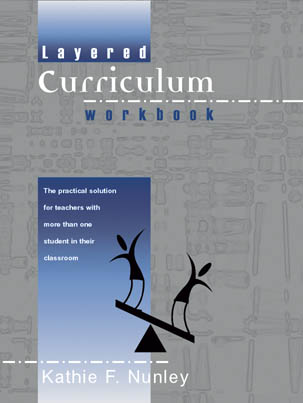
Layered
Curriculum TEXT & WORKBOOK
Set
for only
$43.95
(free shipping in
US)
Tweet
In Defense of the Oral DefenseBy Dr. Kathie F. Nunley
(From ASCD's Classroom Leadership, February 2000)
Like many other teachers, I have been failed when using written evaluations as the single method of assessing student learning. I would spend hours designing a test only to be disappointed with the results. Students didn't study, too often they just guessed their way through the multiple choice, then left the short answer questions blank. Even those that seriously tried to do well rarely reviewed the teacher comments on their returned tests, and they seldom thought of their errors as a source of learning.
It bothered me that students were coming into my class with 10 years of public education but thought that the goal of a test--or any assignment, for that matter-- was just to get something on paper, put their name at the top, and turn it in. The idea that they should have learned something from the experience never entered their heads. So I changed my methods. Now, instead of a written test, I use an oral assessment as the primary means of evaluation. Students must explain to me what they have learned to receive points or credit.
Worth the Effort
The benefits of oral assessment are enormous. I meet with every student, every day. And what I'm asking my student's to do is think. "Tell me about that idea." I don't understand that definition, explain it another way." "How does this relate to what we learned last week?" These are the sorts of questions I ask students, one on one, every day.
You may be amazed at what your students are and are not learning. So often we see a student in the back of the room who obviously isn't getting it. We intend to make it back there but just never get to him. Then the end of the term arrives, and we really feel we have failed that child.
When you move around to every student , this doesn't happen. Now we correct problems early on. If a student is working out of a textbook that you feel will be a real struggle for him, you can redirect him to something more appropriate. You can straighten out errors in his thinking immediately. You can ask him to elaborate on his ideas to stretch his thinking.
You can also individualize expectations to accommodate various abilities in the classroom. With this individual assessment, you can test for individual growth rather than a general criteria that may fit no one. The one-on-one assessment also shifts student thinking. They now understand that the objective of an assignment is not merely do it but also to learn something from it.
Not as Hard as it Sounds
Many teachers think oral assessment would be overwhelming and too time consuming. It moves quickly even in my large classes of 38-40 students. One reason is that all the assignments I give have a rubric or grading criteria. I post that criteria on the wall so students know what to expect. For example, if students are doing book work (a 15-point assignment), I simply look at their work, choose three questions at random, and ask them to explain the answers to me. I award five points for each correct oral explanation.
Today, my students can't slip by. They are accountable for learning something. You can't lie, cheat, or steal your way through an oral assessment. You either know what you've learned or you don't.
Oral defense allows for clarity and individualized instruction. It reduces cheating. Even the student who copies the answers to a book assignment will have to study that material so they can defend it orally and receive credit. Therefore, to earn points, actual learning is required.
"Layering" the Curriculum to Boost Test Scores
(side bar)Teaching in today's diverse general classroom can seem an almost impossible task. In an attempt to effectively juggle learning styles, multiple intelligences, various languages, disabilities, and abilities, I designed a teaching strategy I call Layered Curriculum.
Each unit of instruction is divided into three layers. Student grades are based on how many layers they complete. The bottom layer, called the C level, has a variety of assignment choices that accommodate a range of abilities. This layer allows students to collect general information on the topic. The B level requires students to apply, create, or problem solve with the information gained at the C level. The A level asks students to do a critical analysis of an issue pertaining to the topic of study.
The biggest concern for teachers who are adopting the Layered Curriculum in their classroom are state-mandated, end-of-the-year exams. Will students who are taught in this type of classroom do well on criterion-referenced tests? That's probably the best feature of this teaching strategy. Nearly all the research coming out in educational psychology supports student-centered instruction to increase long-term learning and retention.
Because students are choosing their own assignments and because they are immediately held accountable for their learning, they tend to do better on end-of-year exams. Apparently, when teachers allow students more involvement in the educational process, the testing issues take care of themselves.
About the Author:
Dr Kathie Nunley is an educational psychologist, researcher and author of several books on parenting and teaching, including A Student's Brain (Brains.org) and the best selling, "Differentiating the High School Classroom" (Corwin Press). She is the developer of the Layered Curriculum® method of instruction and has worked with parents and educators around the world to better structure schools to make brain-friendly environments. In addition, her work has been used by the Boeing Corporation, Family Circle Magazine, the Washington Post, and ABC television.
Email her: Kathie (at) brains.orgCopyright © 1998 - current year by Kathie F. Nunley.
All Rights Reserved.
Layered
Curriculum is a registered trademark developed by
Dr. Kathie F. Nunley.