
__________Layered Curriculum®. . . because every child deserves a special education™_
 |
|
 _
_ 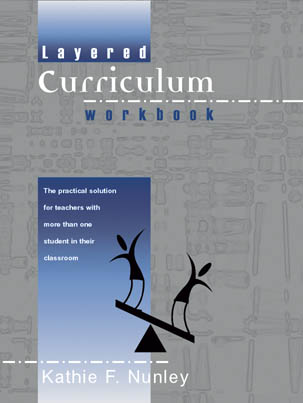
Layered
Curriculum TEXT & WORKBOOK
Set
for only
$43.95
(free shipping in
US)
Tweet
The Research on ReadingBy Dr. Kathie F. Nunley
Reading is the subject of much concern and debate in education. What makes a good reader? What makes a poor reader? How can I help a struggling reader?
While there has been a good deal of research on reading, most of it focuses on explaining reading problems with very little on possible treatment.
Some of the research has been surprising. I think we were all surprised by the research that showed that reading to children at an early age, does not necessarily make for a good or early reader. In fact, sometimes
reading to children can cause just the opposite: something referred to as "the broccoli effect." This comes about if nightly reading is viewed by the parent and the child as a necessary chore. Can you hear the parent who crossly shouts, "turn off that t.v. and get in here...I'm tired and want to get this reading over with, NOW."
If viewed as a daily "have-to" whether you like it or not, reading can actually turn-off a child's love for the activity.
Two things that do show a strong correlation with good readers: early phonemic awareness, and parents who read for personal pleasure. Early phonemic awareness refers to how early someone actually demonstrates or teaches a child that a letter has a sound. The sooner that a child understands that letters symbolize sounds, the sooner he or she reads. But I think the biggest influence is the parents' personal love for reading. Does the child see Mom, Dad, Grandpa, read? Is reading a value in the home reflected by accessibility to books? A parent or caregiver who demonstrates the joy of reading has the biggest influence on a child's reading ability and life-long interest in reading.
Additionally we've seen research showing which regions of the brain are involved in reading. Some research explains that if the wrong parts are involved, or the right parts just aren't dominate enough, then reading problems can occur.
One of the most interesting studies I've seen of late is one that was published in the November 2001 issue of the Journal of Experimental Psychology: Learning, Memory and Cognition. Debra Long from the University of California- Davis and Jennifer Chong from Johns Hopkins University were the co-authors of the study. They looked at comprehension problems among students. They hypothesized that a person who struggles comprehending the story, actually has problems with memory storage and retrieval. Let me briefly summarize their research.
You can time someone's reading speed by using a computer which puts one sentence on the screen at a time. The reader hits the "enter" key to advance the text. The timing process is simply the time between key strokes. As we read, we are fairly consistent in our speed. That is, until we run across something that doesn't make sense. At that point, we drastically slow down and re-read the passage to check for errors or explanation.
To comprehend whether a story makes sense, the reader has to remember previous information from the story, keep it stored and accessible, so that new information can be compared and integrated into previous information - that's what makes the story.
What would happen if there was a limit as to how often (or if ever) you accessed previous information? Long and Chong thought that was what was causing poor comprehension and set out to prove it. They took poor reading comprehenders and good comprehenders and had them read stories, one sentence at a time on a computer screen as I described earlier. They timed their reading speed of each sentence.
In the first story a character named Mary was described as a strict vegetarian. Several passages later, the story described Mary going into a restaurant with a friend and ordering a cheeseburger and fries.
You may be able to guess at this point what the researchers found. In the students with good reading comprehension, their reading speed slowed down considerably when they read the sentence about Mary ordering a cheeseburger, indicating a conflict and confusion over what they had been previously led to believe about Mary. This would require that they remembered the information in the earlier passages and were comparing new information to this old information.
The poor comprehenders did not. In fact, they read through the sentence about Mary ordering a cheeseburger, at the same rate they'd been reading all along. This indicates that they were not comparing this new information to the previous information as they read. Perhaps they just did not understand.
Not according to the second test. Here they presented the same basic story in the same manner. But now, they separated the original information from the conflicting information by only one sentence, a reading time of just a couple of seconds. In this second test, the poor comprehenders slowed down their reading to about the same extent of the good comprehenders.
What does this study show? Working memory, that which you have in your consciousness right now, lasts for about 20 seconds. New information or just the passage of time, moves things out of your working memory and stores it for long term access when you need it..
Apparently poor reading comprehenders will not access this stored information while reading. They will make comparisons if the information is in their working memory, but apparently don't make the continuing access to long term memory that good comprehenders do.
What can teachers do with this information? How can we best help the struggling reader with comprehension? Can they be trained to access stored information better? I think so. Memory can be trained and improved in all sorts of situations, so why not reading too. Teachers may find it helpful to verbalize this process out-loud. Stop periodically and discuss how new information about a character or situation compares with previous information.
Formally instruct students on the importance of storing and referring back to information during reading. Students may also want to jot down ideas as they go along and then refer back to these written items as they move through a story.
Teachers can do much to help poor readers. We find them at all grade levels. It is important to remember that poor reading is not the result of low IQ. In fact, intelligence and reading ability have never correlated. Even the most brilliant child may have difficulty reading. As parents and educators I think we can gleam some hints and ideas from the research.
Start early to teach letter - sound relationships. Read for personal pleasure in front of children. Find memory aids or memory exercises to help students improve comprehension.
Never let a child think his or her struggles with reading are a reflection of overall ability or intelligence. There is a reader in every child.
Sources:
- Applied Psycholinguistics. 2000 Vol 21(2) 229-241.
- Journal of the American Academy of Child & Adolescent Psychiatry. 2000 Vol 39(7) 859-867.
- Journal of Experimental Psychology: Learning, Memory and Cognition. 2001 Vol 27, (6), 1424-1429.
- Learning & Individual Differences. 1999 Vol 11(4) 377-400.
- Reading & Writing. 2000 Vol 12(1-2) 129-142.
- Reading & Writing. 2000 Vol 13(1-2) 81-103
- Reading Psychology. 2000 Vol 21(3) 195-215.
About the Author:
Dr Kathie Nunley is an educational psychologist, researcher and author of several books on parenting and teaching, including A Student's Brain (Brains.org) and the best selling, "Differentiating the High School Classroom" (Corwin Press). She is the developer of the Layered Curriculum® method of instruction and has worked with parents and educators around the world to better structure schools to make brain-friendly environments. In addition, her work has been used by the Boeing Corporation, Family Circle Magazine, the Washington Post, and ABC television.
Email her: Kathie (at) brains.orgCopyright © 1998 - current year by Kathie F. Nunley.
All Rights Reserved.
Layered
Curriculum is a registered trademark developed by
Dr. Kathie F. Nunley.