
__________Layered Curriculum®. . . because every child deserves a special education™_
 |
|
 _
_ 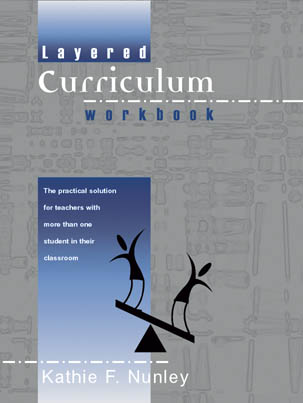
Layered
Curriculum TEXT & WORKBOOK
Set
for only
$43.95
(free shipping in
US)
Tweet
How to begin Layered Curriculum®:
Read this before beginning!By Dr. Kathie F. Nunley
If it hasn't already occurred to you, it is more than a little risky to design a beautiful Layered Curriculum unit this weekend full of choice and variety and walk into your classroom Monday, hand it to your students and say "Well here you go. You have 2 weeks to do whatever you want. Have fun." Aarrrgghhhhh! You will fail and so will your students.
Unless you have a room of students fresh out of the neighborhood Montessori school, most students have no idea how to operate in a student-centered classroom. And most teachers don't know how to manage a student-centered classroom. So the best advice - go slow. Start with what you do right now and add one component. See how that goes, then add one more piece.
A popular way to begin is to make your unit sheet look like a daily assignment sheet.
e.g.: Day one: Listen to the lecture and choose one of the following two assignments:
1. xxxxxxx
2. xxxxxxxWith this "daily method" you will start the class period with some whole class instruction, then offer the students a choice of two or three assignments which follow your instruction. They must complete one by the end of the class period. Most students can handle that as it looks familiar. They listened to some instruction and now they choose one of two activities to complete within the class time.
You can design your whole first unit using this daily method. Students only have to choose between 2 or 3 assignments on any given day and deadlines are strict (something is due today). Homework may or may not be added depending on your subject.
This same advice holds true with assessment. Many teachers start out thinking they have to visit with every student every day about every assignment! That's a great goal, but give yourself time to work up to it. Oral assessment gets more efficient with practice - yours and the students. Start by just discussing one assignment in the unit. Or let the students put a portfolio together and have them select one or two to discuss with you.
Try grading a day behind the students - you grade today's assignments tomorrow while they are working on the current day's work. Have students turn in work every day, but you will visit with them tomorrow.
Finally, start with very short Layered Curriculum units. Two or three days works well, or maybe one week. Keep in mind that your first unit probably won't run smoothly. There will be much you want to change. If you keep it short, you only have to weather a short storm.
Teachers who persist through three units seems to have mastered Layered Curriculum. Don't get discouraged. Start with lots of structure, a format that looks familiar to both you and your students and be prepared to make some mistakes in the beginning. But your efforts are greatly rewarded as students learn to take responsibility and control of their own learning and you feel valued as their facilitator.
About the Author:
Dr Kathie Nunley is an educational psychologist, researcher and author of several books on parenting and teaching, including A Student's Brain (Brains.org) and the best selling, "Differentiating the High School Classroom" (Corwin Press). She is the developer of the Layered Curriculum® method of instruction and has worked with parents and educators around the world to better structure schools to make brain-friendly environments. In addition, her work has been used by the Boeing Corporation, Family Circle Magazine, the Washington Post, and ABC television.
Email her: Kathie (at) brains.orgCopyright © 1998 - current year by Kathie F. Nunley.
All Rights Reserved.
Layered
Curriculum is a registered trademark developed by
Dr. Kathie F. Nunley.